
- July 9, 2026 - 5:00 PM
- 2h
- Gordon Hall, Music Mountain
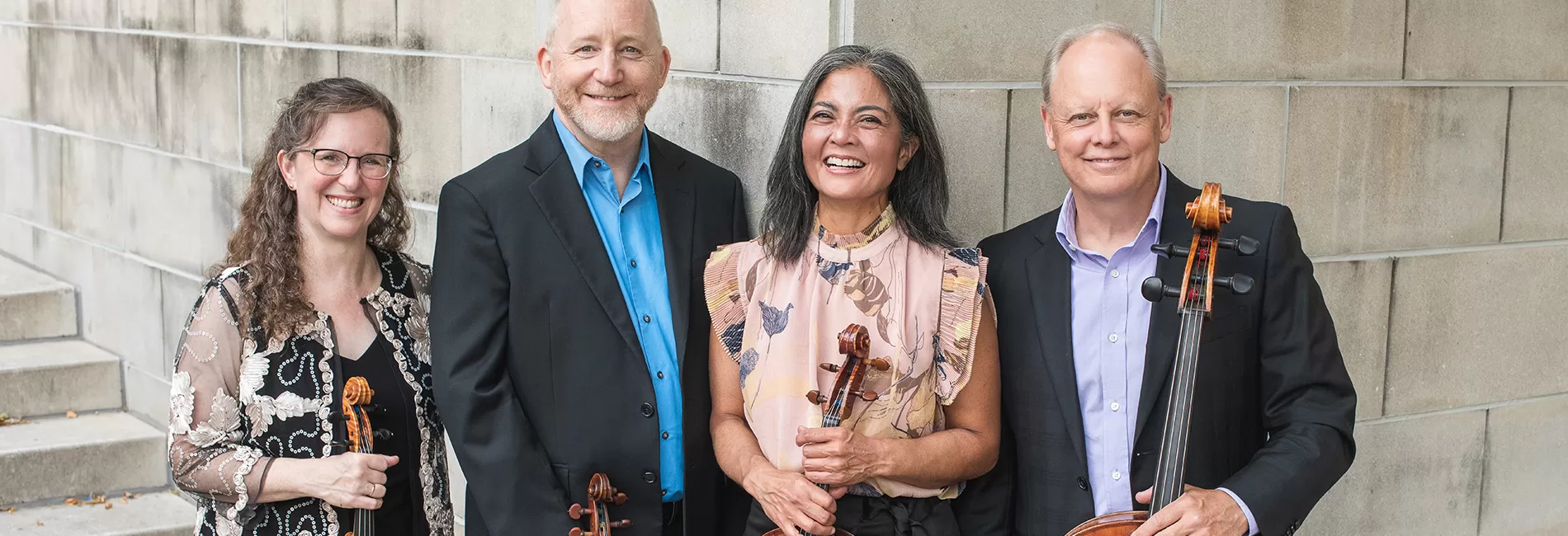
Arianna String Quartet Rescheduled
Rescheduled from Sunday to Thursday at 5 PM.
Felix MENDELSSOHN String Quartet in F Minor, Opus 80
Gabriela LENA FRANK Kanto Kechua #4, “For Béla”
Pyotr TCHAIKOVSKY String Quartet in D Major, Opus 11
Pre-Concert Talk by Fred Baumgarten at 2:00 PM
WHO’S BURIED IN AUDUBON’S TOMB? THE ARTIST AND THE MUSICIAN IN THE NEW WORLD
Including four musical excerpts from Heinrich's song cycle, "Sunset Chimes," to be performed by pianist Neely Bruce and tenor Steve Hoagland
PROGRAM NOTE
Gabriela Lena Frank (b. 1972)
KANTO KECHUA #4, “FOR BÉLA” (2025)
Music Mountain congratulates Gabriela Lena Frank on her latest award, the 2026 Pulitzer Prize in Music. Music Mountain has been an advocate for Gabriela Lena Frank's music, having presented her piano quintet in 2007, and her string quartets thereafter.
Cultural heritage has always been at the center of composer/pianist Gabriela Lena Frank's music. Born in Berkeley, California, to a mother of mixed Peruvian/Chinese ancestry and a father of Lithuanian/Jewish descent, Frank explores her multicultural heritage most ardently through her compositions. She has traveled extensively throughout South America, and her pieces often reflect and refract her studies of Latin American folklore, incorporating poetry, mythology, and native musical styles into a Western classical framework that is uniquely her own. Frank is the winner of the 2026 Pulitzer Prize in Music, and on the Washington Post's list of the 35 most significant women composers in history.
Kanto Kechua No. 4 For Bela was written for the Arianna String Quartet in 2025.
The composer writes:
Béla Bartók was a founding mentor for me when I was a young student in school, looking for heroes. While I respected and often loved the classical music I was learning, as a young Latina woman, I was aware of its narrow cultural representation. Bartók was a revelation — After my first experience playing his work, I felt he was a Latino in a previous life... and I know now that I was responding to his exploration of a people's music from folk and indigenous traditions with roots older than classical music. That ethos became a guiding light for me for my own exploration of Peruvian-indigenous and other Latin American cultures.
Kanto Kechua No. 4 belongs to a series of "Quechua songs" with "Quechua" referring to the language Peruvians inherited from the Incas centuries ago. These are intimate pieces, not overly-long, that tie my roots to things dear to me as Bartok is. In this piece, I hint at shapes and gestures that can be found in Bartók's own youthful work, his first string quartet. It's a tribute to his own first steps in finding his voice.